Predictive Tariff Code Classification for Shopify
Predictive tariff code classification — built for Shopify catalogs
International selling requires tariff codes. Shopify doesn't manage them. And most merchants only think about them after something breaks.
Predictive Tariff Code Classification is a Shopify-native app that continuously proposes tariff codes as your catalog changes — with human review, reasoning, and audit history built in. Nothing is applied without your approval.
Tariff codes get copied once. Then forgotten.
Tariff codes are treated as static metadata — but your catalog is not static. Products change. Variants multiply. Materials evolve. Compliance quietly drifts.
Reactive compliance
Issues surface after a shipment is delayed or rejected, not when the catalog changes.
Stale classification
Codes get copied once, then reused even as product details shift.
No audit trail
When questions arise, there's no rationale or decision history to point to.
Broken workflows
Data lives in spreadsheets instead of the Shopify catalog teams rely on.
How Predictive Tariff Code Classification works
Predictive classification, human review, and audit-ready documentation — built into Shopify.
1. We monitor catalog changes
New products, updated descriptions, variant changes — your Shopify catalog is continuously analyzed.
2. We propose codes, not guesses
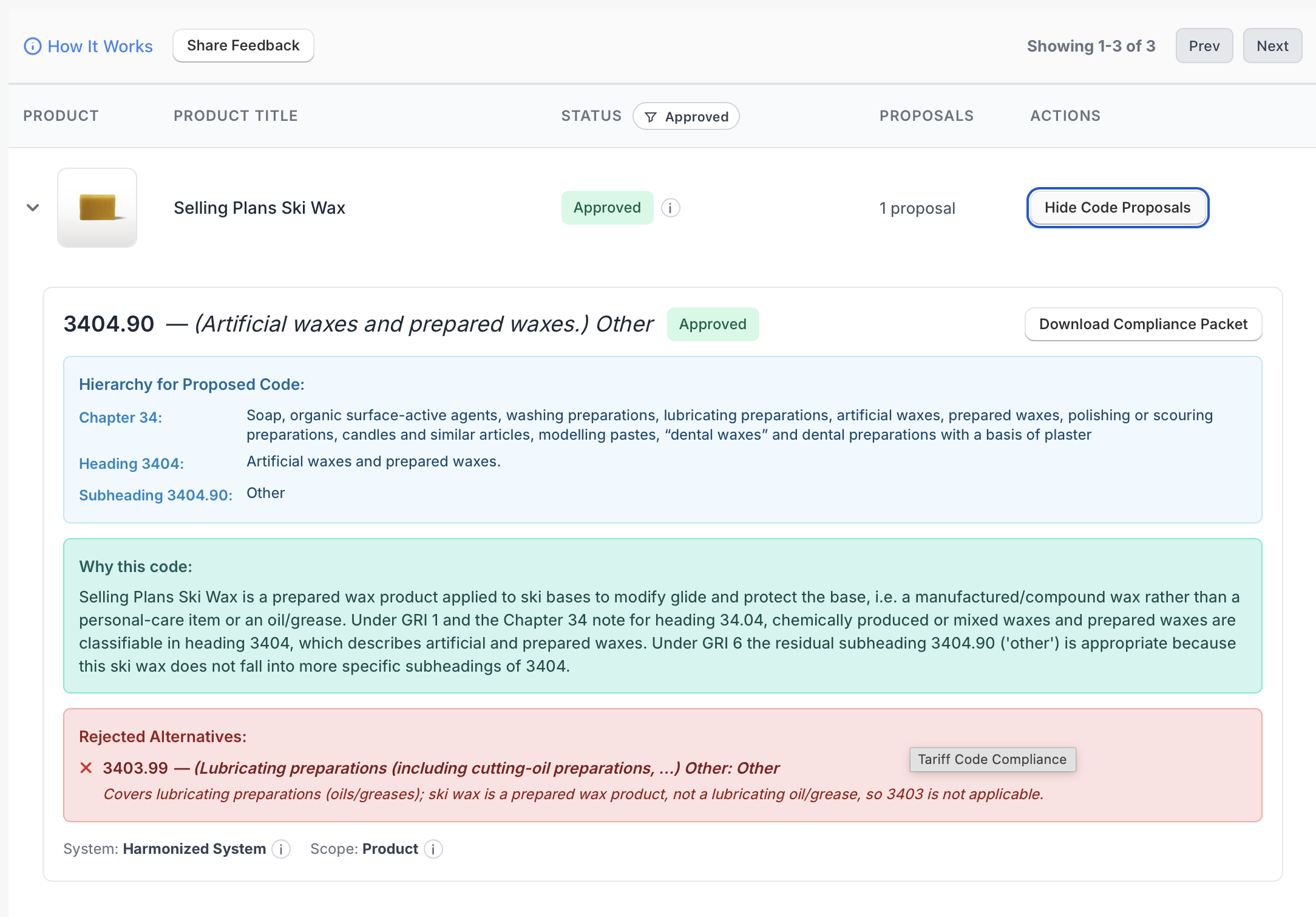
Each proposal includes tariff codes, hierarchy context, rationale, and supporting notes.
3. You review and approve
Nothing is automatically applied. You approve, reject, or revisit later — in Shopify.
4. You get audit-ready documentation
Every approved code includes a downloadable compliance packet with rationale and approval history.
What makes this different from “AI classification”
Most tools try to auto-assign codes and move on. Predictive Tariff Code Classification is built around reviewability: proposals are explainable, decisions are logged, and changes are traceable over time.
This isn't about replacing judgment — it's about making good judgment easier, faster, and repeatable.
Review-first by design
- • Predictive proposals tied to catalog changes
- • Clear rationale and classification hierarchy
- • Full approval history and audit packet
- • Humans stay in control of final decisions
Designed for real Shopify catalogs
Built to handle product and variant growth without pulling you into side systems.
Works across products and variants
Classification adapts to SKU and variant-level changes.
Handles catalog growth
Continuous monitoring prevents re-work as you scale.
Fits existing workflows
Integrates with Shopify operations and fulfillment processes.
No spreadsheets or side systems
You stay inside Shopify while staying compliant.
Who this is for
If tariff codes are already a recurring problem — or about to become one — this is built for you.
International Shopify merchants
Selling across borders without breaking compliance.
Ops teams tired of tariff metadata
Reduce manual fixes and last-minute scrambles.
Brands preparing for audits
Get decision history and rationale on demand.
Growth-focused catalogs
Stay compliant as new products roll out.
Start small, scale when you need to
Try Predictive Tariff Code Classification with a free plan that includes a limited number of code proposals. Upgrade only when it's providing real value.